In Praise of Michael Connelly’s Short Stories
Fans of Michael Connelly tend to be a devoted, slightly obsessive bunch. Those of us who have spent years following Harry Bosch through the corridors of the Hollywood Division or the lonely canyons of his personal life know the familiar frustration: there’s never quite enough Bosch. Connelly puts out the novels, but the recent efforts are not pure Bosch novels as he shares the billing with Ballard or Maddie.
Fortunately, there’s a solution hiding in plain sight – Connelly’s short fiction.
These stories, available individually or in small collections through retailers like Amazon, form something close to a secret annex to Connelly’s larger body of work. Some feature Harry Bosch, others focus on new characters. Taken together, they amount to a rich, unofficial anthology that rewards loyal readers with a companion to the novels. They lack the elaborate architecture of Connelly’s longer works—the slow burn, the mounting tension, the devastating climax—but they offer something arguably more fascinating: direct access to the machinery of Connelly’s craft.
Reading these stories feels like you’re rummaging through a cluttered attic filled with police lore. Connelly has always been a meticulous researcher, and his short fiction gives him the freedom to explore corners of the law enforcement world that might otherwise never make it into a full-length novel.

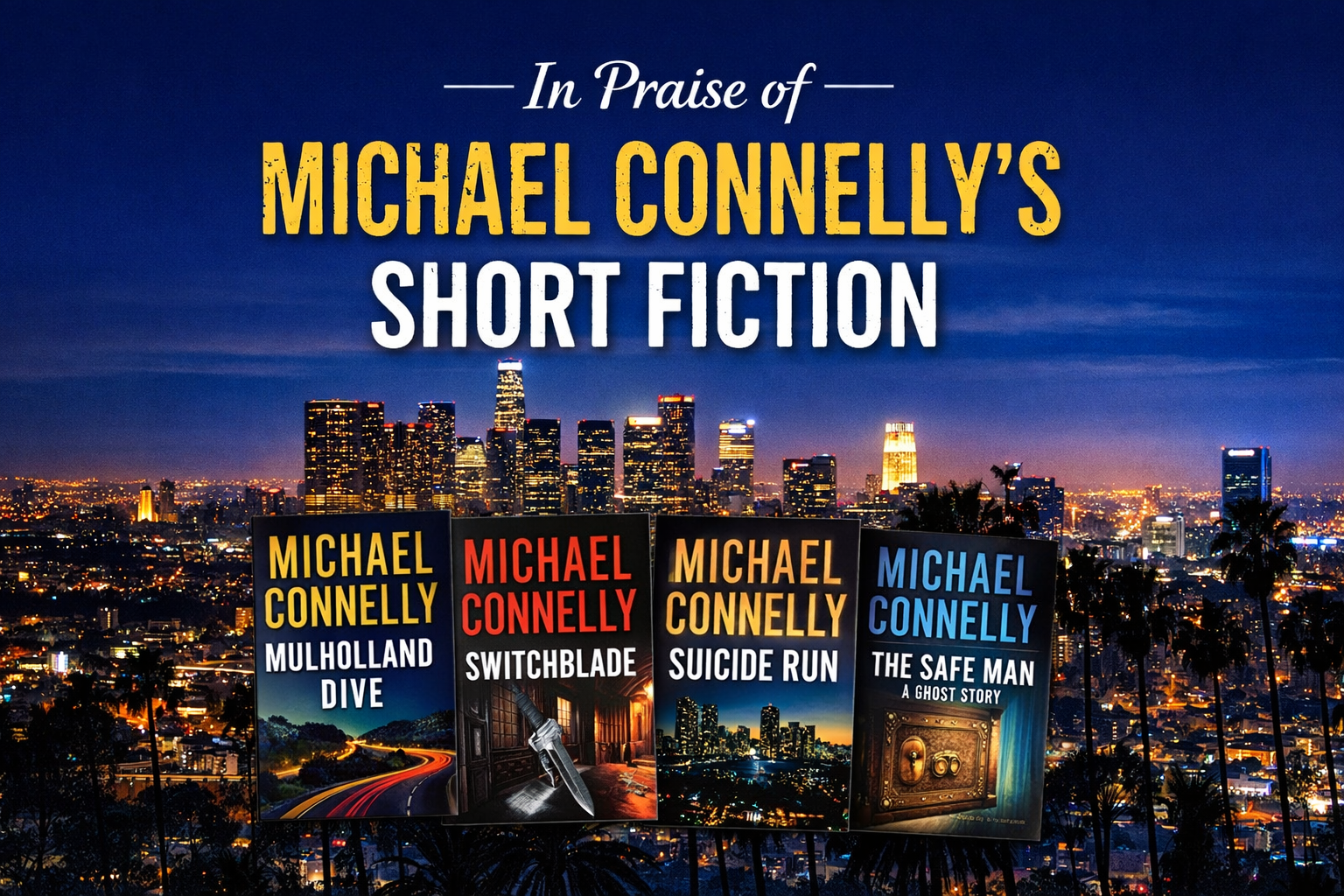
Take “The Safe Man: A Ghost Story”. It follows Brian Holloway, a specialist hired to open an antique safe belonging to a famous author. Connelly ventures into the paranormal – unknown territory for him – but does so with restraint and precision. What makes the story memorable isn’t the inclusion of ghostly elements so much as the fascinating detail about safecracking itself and the mechanics of vintage safes. Connelly doesn’t just tell a story; he reveals an entire hidden profession.
Similarly, “Mulholland Dive” introduces Detective Clewiston, an accident reconstructionist. This is a niche within policing that Connelly has rarely explored elsewhere. The story reads almost like a field report, immersing the reader in the grim, technical process of determining how and why a fatal crash occurred. It’s easy to see why such material might be difficult to sustain over a full novel – but in short form, it’s perfect: focused, atmospheric, and quietly absorbing.
For Bosch devotees, the crown jewel is undoubtedly Suicide Run, a trio of stories that follow Bosch at different stages of his career. The title story places him at the Hollywood homicide table during his glory years. He’s partnered with Jerry Edgar and overseen by Harvey Pounds, while he begins to encounter future allies like Kiz Rider. Reading this story is like visiting an old friend. Bosch is fully himself here: relentless, intuitive, and quietly burdened.
“Cielo Azul” is especially striking. It’s told in the first person, a rarity for a Bosch story. But what’s truly striking for Bosch fans is that the action takes place before the first Bosch novel, The Black Echo. It’s the only prequel in the Bosch series. Bosch is young and determined. His partner is Frankie Sheehan, who plays such an important role in the early novels. And he meets FBI profiler Terry McCaleb for the first time.
The collection concludes with “One Dollar Jackpot”, in which Bosch is working Homicide Special with Ignacio Ferras. Bosch solves a case of a murdered poker pro through cunning rather than brute persistence. It’s a reminder that Bosch’s greatest weapon has always been his intellect, his ability to see patterns others miss.
Connelly’s terse, economical prose is ideally suited to the short story format. He wastes nothing. There’s no need for elaborate backstory; Bosch arrives fully formed, carrying decades of fictional history with him. This allows Connelly to focus on what he does best: spinning a great tale out of his flawless research.
Even in his novels, Connelly often pauses to share strange, revealing anecdotes from police culture (sort of short stories within novels). In A Darkness More than Night, for example, Terry McCaleb tells the story of two Minnesotans who fatally shot each other, after which the cops found frozen used tampons in one man’s freezer. They called in the FBI lab at Quantico, thinking these might be trophies from a truly twisted serial killer. McCaleb figured out that they were using them as bear bait during hunting season. These moments of odd authenticity are Connelly’s signature, and his short stories are filled with them.
Best of all, these stories offer something priceless: more time in Bosch’s world. They are not essential to understanding the novels, but they deepen and enrich them. They provide new angles, new textures, new glimpses into familiar lives.
For longtime readers, they feel like rediscovered memories. And for anyone who has ever wished for just one more Bosch story, they are reason enough to celebrate Connelly’s shorter work.
* * *
Hi. I’m Peter Moreira and my latest novel is the technothriller Presidio Biotech. I’m also the author of The Haight Mystery Series — retro mystery novels set in San Francisco in the late 1960s. Go to my home page to join my mailing list and receive a free prequel novella.