Positively Bob Dylan’s Greatest Poem
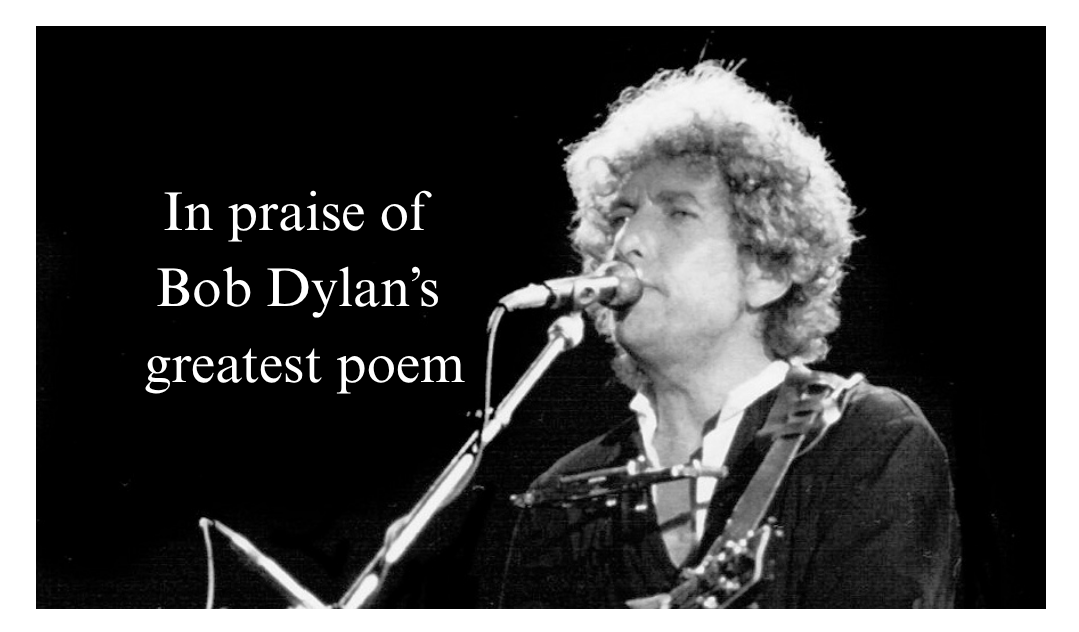
Two things have brought Bob Dylan to mind this spring. Most obviously, he celebrated his 85th birthday this past Sunday. And second, Bruce Springsteen decided to end several shows in his Land of Hope and Dreams tour with his cover of Dylan’s “Chimes of Freedom”.
For my money, this is Dylan’s greatest poem – not his greatest song, but his greatest poem. And Springsteen and the E Street Band’s version is tremendous, even in its abridged form. They first performed the song in Stockholm in 1988, when Springsteen announced that he would be joining the multi-artist Human Rights Now! Tour in support of Amnesty International. Later that year, he released the live performance as the title track on an EP.
Originally appearing on Dylan’s 1964 album Another Side of Bob Dylan, “Chimes of Freedom” tells a small story. Dylan and a companion or companions are caught outside one evening when a sudden thunderstorm breaks out, so they duck inside a doorway to keep dry. A wedding was taking place nearby and the wedding bells pealed as the flashes of lightning filled the sky. It was as if the chimes themselves were causing the lightning, or vice versa.
Though Dylan was moving away from protest songs at the time, he was still influenced in his poetry by the prevailing ethos of the human rights movement. “Chimes of Freedom” was not a “protest song” in the strict meaning of the term. He wasn’t denouncing injustice or war or criticizing the government. Rather, he penned an anthem for humanity, a song that radiated with love of all people, especially the least fortunate.
To deliver this benevolent message, Dylan wrote a brilliant poem (to refer to it as “lyrics” just doesn’t do it justice) in which radiant imagery exists within a fascinating structure. It comprises six verses, each with eight lines and an unusual ABCBDDDE rhyming scheme. No chorus or bridge.
The first four lines of each verse tell the tale of the thunderstorm and the interplay of the chimes and lightning flashes. The descriptions of the storm – “the mad mystic hammering of the wild ripping hail” – are as vivid as anything in the Dylan canon. In particular, Dylan employs synesthesia – a poetic device in which one sensory experience is described in terms of another – to describe the sights and sounds of the chimes and lightning. The first half of each verse is rife with lines like “majestic bells of bolts struck shadows in the sounds” that intermingle sight and sound – the flashing, striking and above all the tolling.
In the second half of each verse, Dylan tells us who the bells/lightning are tolling/flashing for in his mind. They seemed to be “the chimes of freedom”, he says, tolling in the first verse for pacifists, refugees and underdog soldiers. In the subsequent verses, he continues this roll call of the misbegotten – the rake, the single mother, the falsely accused inmate – and also the benevolent, gentle and kind.
In the final verse, Dylan uses a splendid blend of rhythm, rhyme and alliteration to conclude the bells are chiming for the “countless confused, accused, misused, strung-out ones and worse.” In short, he says they’re tolling for every hung-up person in the universe.
If anything shows that Dylan was a worthy recipient of the Nobel Prize for Literature, it is “Chimes of Freedom”. With its electrifying imagery and glowing humanity, it’s a wonderful poem. Its use of synesthesia harkens back to Arthur Rimbaud (a pioneer of the technique) and the emphasis on the tolling bells is an obvious allusion to John Donne’s “No Man Is an Island”, another anthem of shared humanity.
As a poem, it deserves to be studied in parallel with those great poets. And as a song, it deserves to be covered by a rock and roll titan like Bruce Springsteen in his tour celebrating common Americans.
***
Hi. I’m Peter Moreira and my latest novel is the technothriller Presidio Biotech. I’m also the author of The Haight Mystery Series — retro mystery novels set in San Francisco in the late 1960s. Go to my home page to join my mailing list and receive a free prequel novella.